The Challenge
The warehouse manager at a consumer goods distribution facility in Taman Perindustrian Puchong was dealing with a persistent rat problem that was threatening their business operations. Norway rats (Rattus norvegicus) were entering the warehouse nightly, gnawing through product packaging, contaminating stored goods, and leaving droppings throughout the facility.
The financial impact was significant. The company was writing off damaged stock monthly, and their major client — a national retail chain — had flagged rodent-related product damage in two consecutive quality audits. A third failure would jeopardise the contract.
The warehouse had been using a basic pest control service involving monthly bait station checks. While the bait was being consumed, the rat population wasn't declining because new rats kept entering from outside. The fundamental problem wasn't the rats inside — it was the building's inability to keep them out.
Our Assessment
Our team conducted a comprehensive building survey during evening hours when rat activity peaks. We used UV tracking powder and CCTV monitoring at suspected entry points to map movement patterns. Key findings:
- Primary entry: 40mm gap beneath the main loading dock roller shutter — rats were entering freely when the door was closed overnight
- Secondary entries: Damaged vent grilles on the side wall (3 units), gaps around drainage pipes at floor level (2 locations), and a 50mm hole where an old cable conduit penetrated the rear wall
- Harbourage: Rats were nesting in the false ceiling above the office area and behind racking units along the perimeter wall
- Food source: Despite good housekeeping, damaged product packaging on lower racking provided an easy food source
- Species: Primarily Norway rats, with evidence of roof rat (Rattus rattus) activity in the ceiling space
We identified 14 potential entry points in total. The building, being an industrial unit approximately 20 years old, had accumulated structural gaps from decades of use, equipment installations, and general wear.
The Treatment Plan
We designed a three-phase programme focused on the principle that exclusion is the foundation of lasting rodent control. Baiting alone only manages the symptom — physical exclusion addresses the cause.
Phase 1: Exclusion Works
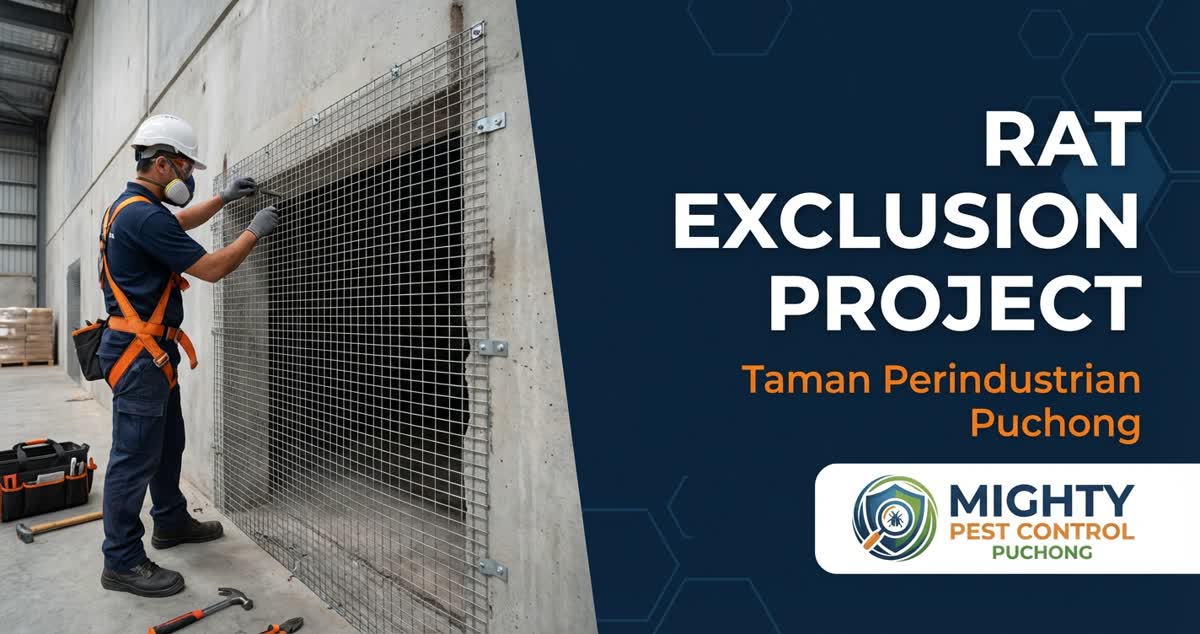
Our team sealed all 14 identified entry points using materials selected specifically for rat-proofing:
- Loading dock: Industrial-grade PVC strip curtains installed across the full width of the dock opening, combined with a galvanised steel kick plate along the bottom edge to prevent gnawing. The strips allow forklift passage while blocking rodent entry
- Pipe penetrations: Stainless steel mesh (1mm gauge) packed tightly around all pipe entries and sealed with polyurethane expanding foam. Steel mesh is critical — rats can gnaw through foam, wood, and even soft metals, but not through steel mesh
- Damaged vents: All 3 vent grilles replaced with heavy-duty galvanised mesh units rated for industrial use
- Cable conduit hole: Sealed with steel plate and mesh combination, welded in place
- General gaps: All gaps exceeding 10mm along the building perimeter were sealed with cement mortar embedded with steel mesh
Phase 2: Population Knockdown
With entry points sealed, we focused on eliminating the existing indoor population:
- 12 tamper-resistant bait stations positioned along internal walls, behind racking, and in the ceiling space
- Bait loaded with brodifacoum — a single-feed anticoagulant effective against resistant rat populations
- 6 snap traps placed at confirmed movement paths for rapid knockdown
- All traps and stations documented on a facility floor plan with numbered locations for audit compliance
Phase 3: Monitoring Programme
We established a fortnightly monitoring schedule for the first 3 months, then monthly ongoing. Each visit includes:
- Inspection of all bait stations and traps — consumption recorded and bait refreshed
- Physical check of all exclusion points for signs of gnawing or damage
- UV powder tracking at 3 sentinel points to detect any new activity
- Written report with photographic evidence for the client's quality compliance records
Results
- Week 1-2: High bait uptake in existing stations — expected as trapped indoor population feeds heavily
- Week 3-4: Bait consumption declining sharply. 4 rats caught in snap traps. No new droppings on product racking
- Week 6: Near-zero bait consumption. No fresh droppings or gnaw marks detected anywhere in facility
- Week 8: Full facility survey confirmed zero active rodent presence. Exclusion points intact
✅ Project Results
- Zero rodent intrusion confirmed at 8 weeks post-exclusion
- 14 entry points permanently sealed with industrial-grade materials
- Passed client quality audit with no rodent-related findings
- Product damage write-offs eliminated completely
- Monthly monitoring programme ongoing with full compliance documentation
- Loading dock strip curtains also improved temperature control — bonus energy saving
Why Exclusion Works Better Than Baiting Alone
Many warehouse and factory managers spend thousands of ringgit annually on rodent baiting programmes that never actually solve the problem. Bait kills individual rats, but as long as the building has open entry points, new rats from the surrounding environment simply replace them. It's an expensive treadmill.
Physical exclusion breaks this cycle. By sealing the building envelope, you stop the continuous influx. Combined with a short-term baiting programme to clear the existing indoor population, the result is permanent — as long as the exclusion work is maintained and inspected regularly.
For industrial facilities in areas like Taman Perindustrian Puchong, where warehouses are surrounded by open drains, vegetation, and food waste, exclusion isn't optional — it's the only approach that delivers lasting results. Our rodent control services always start with a building survey because we've learned that treating the symptom without fixing the cause is a waste of everyone's time and money.
Rat Problems in Your Warehouse or Factory?
We provide comprehensive rodent exclusion and control programmes for commercial and industrial facilities across Puchong.
📱 WhatsApp Us for Site SurveyOr call 03-6096 0068