The Challenge
The homeowner at this semi-detached property in D'Villa Residence, Bandar Puteri, first noticed something was wrong when their ground-floor door frame crumbled during routine maintenance. What appeared to be solid timber was hollow inside — consumed almost entirely by subterranean termites.
Our initial inspection revealed the problem was far more extensive than a single door frame. Active mud tubes were found along the internal party wall in the ground-floor bathroom, behind the kitchen cabinets, and along the external foundation wall near the garden. The colony had likely been active for over two years.
The property, built approximately 12 years ago, had received pre-construction soil treatment during development. However, as with most chemical soil barriers, the treatment had degraded over time and was no longer providing effective protection.
Our Assessment
Using moisture meters and thermal imaging, our team mapped the full extent of termite activity throughout the property. Key findings included:
- Active foraging trails along 3 internal walls on the ground floor
- Moderate damage to 4 door frames and the kitchen cabinet backing
- Mud tubes extending from the soil through a gap in the floor slab where the bathroom drain pipe penetrated
- No visible damage to structural timber (roof trusses), but early-stage activity detected in one ceiling joist via thermal scan
We identified the termites as Coptotermes gestroi, the most common and destructive subterranean species in peninsular Malaysia. The colony appeared mature based on the volume of foraging activity.
The Treatment Plan
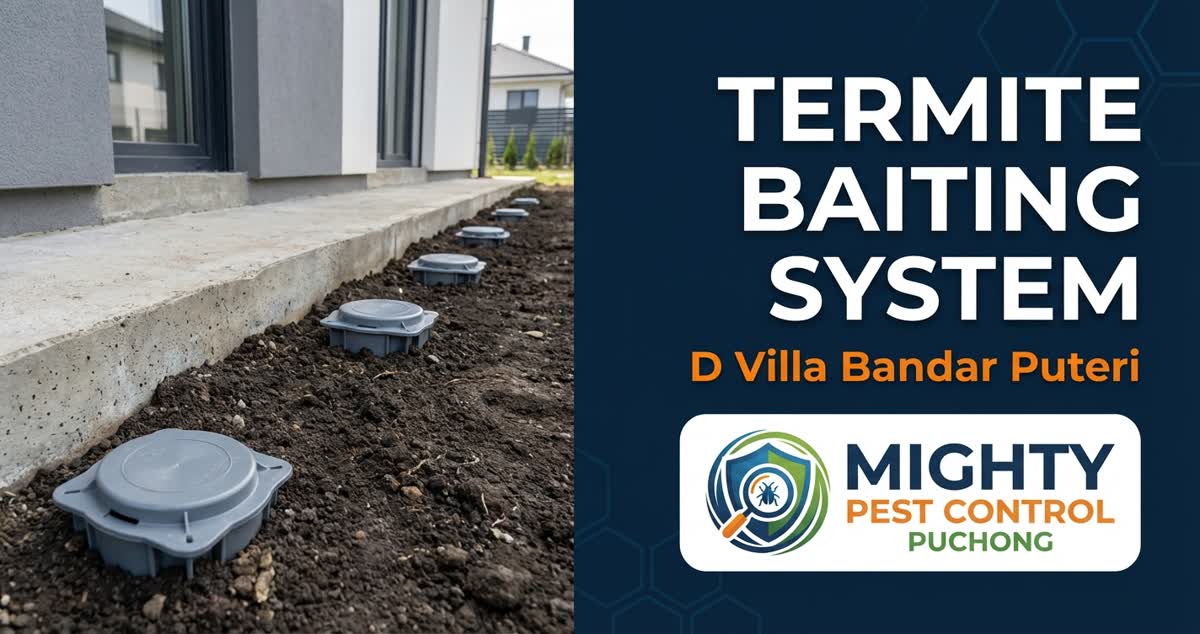
We recommended a dual-approach strategy combining the Sentricon In-Ground Termite Baiting System with targeted soil treatment at identified entry points.
Phase 1: Sentricon Baiting System Installation
We installed 16 Sentricon in-ground monitoring stations at 3-metre intervals around the entire perimeter of the property. Stations were placed in the soil approximately 30cm from the building's foundation wall. Each station contained Recruit HD bait matrix — a chitin synthesis inhibitor that termite workers carry back to the colony.
The beauty of a baiting system over traditional chemical barriers is that it doesn't just repel termites — it eliminates the entire colony, including the queen. Workers feed on the bait, share it through trophallaxis (mouth-to-mouth feeding), and the active ingredient gradually prevents the colony from sustaining itself.
Phase 2: Soil Barrier at Entry Points
While the baiting system works on long-term colony elimination, we needed to cut off the active foraging routes immediately. We applied a non-repellent termiticide (Termidor SC, fipronil-based) to the soil around the three identified entry points — the bathroom drain pipe penetration, a crack in the garage floor slab, and the external foundation gap near the garden tap.
Non-repellent formulations are critical here. Repellent chemicals would cause the termites to simply find a new route. Non-repellent products allow termites to pass through the treated soil unknowingly, pick up the active ingredient, and transfer it to colony members.
Phase 3: Damage Repair Guidance
We advised the homeowner to hold off on repairing damaged door frames and cabinets until colony elimination was confirmed. Premature repairs can seal in residual termite activity and make monitoring harder. We provided a detailed report for their renovation contractor outlining which elements needed replacement.
Monitoring & Results
Our team conducted fortnightly monitoring visits over the following 12 weeks:
- Week 2: Bait uptake confirmed in 6 of 16 stations — strong indicator of active foraging routes
- Week 4: Significant bait consumption observed. Indoor mud tube activity visibly reduced
- Week 6: Bait consumption slowing, suggesting colony stress. No new mud tubes observed indoors
- Week 8: Minimal bait activity. Indoor monitoring confirmed zero termite presence. Colony elimination achieved
- Week 12: Confirmation visit — all stations show no activity. Homeowner cleared to proceed with repairs
✅ Project Results
- Complete colony elimination confirmed at 8 weeks
- Zero termite activity detected at 12-week follow-up
- 16 permanent monitoring stations remain in place for ongoing protection
- Homeowner enrolled in annual monitoring programme
- Structural damage limited to non-load-bearing elements — no major repairs needed
Why Baiting Works for Semi-D Properties
Semi-detached homes like those in D'Villa present unique termite treatment challenges. The shared party wall means you can't always treat the full perimeter with soil chemicals. Baiting systems work around this limitation because they target the colony itself, regardless of where the nest is located — even if it's under your neighbour's property.
The Sentricon stations also provide permanent, ongoing monitoring. Unlike chemical barriers that degrade over 5-8 years, bait stations can detect new colony activity indefinitely as long as they're maintained. For a property in a mature development like Bandar Puteri, where surrounding soil conditions are ideal for termites, this ongoing vigilance is essential.
Concerned About Termites in Your Home?
We provide thorough termite inspections and customised treatment plans for homes across Puchong.
📱 WhatsApp Us for Free InspectionOr call 03-6096 0068